en
A working guide to choosing, equipping and living with a telehandler on a real farm — written from the loader seat rather than the showroom floor.
Ask anyone who has run a telehandler for a few seasons and the story is always the same. The machine stops being a novelty about a week after it arrives. What started as a way to shift a few bales becomes the loader that fills the grain trailer, stacks the straw, lifts a pallet of seed off the lorry, and reaches the roof sheet that came loose in March.
That is the honest appeal of an agricultural telehandler. It is not a tractor with a loader bolted on. It is a purpose-built load-handling machine with a boom that travels up and forward, a quick-attach headstock, and a chassis balanced for lifting rather than pulling. The difficult part was never deciding whether you want one. It is specifying the right one.
A forklift is superb at what it was designed for and hopeless at almost everything else on a farm. Packed gravel, a muddy gateway, a slight slope, a load that has to go over a barrier rather than into a gap — each of those ends the forklift's day fairly quickly.
A tractor loader is the opposite compromise. It will go anywhere and pull anything, but the geometry of a front linkage limits both lift height and forward reach, and the operator spends a lot of the day looking at the back of a bucket.
The telehandler takes the load-handling end of the forklift and the go-anywhere chassis of the tractor. One boom, one headstock and a set of implements replaces three or four machines — and, just as importantly, replaces the queue of people waiting to borrow them.
Sales literature uses the phrase loosely, so it helps to know what the differences look like in practice. An ag-spec machine is rarely a completely different chassis; it is a different set of priorities.
Compact machines deserve a mention here, because plenty of farms over-specify. If the work is feeding, bedding, stacking and pallet handling around buildings, a short-wheelbase unit such as the JT625 compact telehandler will do more genuinely useful hours in a week than a much larger machine that cannot get between sheds.
 JT625 Compact Telescopic Handler for Tight Farm BuildingsA 2.5 t, 5.95 m compact telehandler about 1.8 m wide for feeding, bedding, stacking and pallet handling between sheds.View Product →
The trade-off is reach, so check the height you genuinely need before you commit. It is far easier to live with a slightly smaller machine than with one that will not fit through the door of the shed it was bought to serve.
The most common buying mistake is specifying for the biggest job of the year rather than the work that happens every week. The second most common is reading capacity at the carriage and forgetting that it falls away as the boom extends.
| Typical task | Working height | Load to plan for | What usually decides it |
|---|---|---|---|
| Feeding and bedding | 3–4 m | 600–900 kg | Soft ground travel and cycle speed |
| Loading grain trailers | 4–6 m | 1,000–1,500 kg | Forward reach over the side, not height |
| Seed and fertiliser pallets | 3–5 m | Up to 1,000 kg | Forks with side shift and fine control |
| Stacking straw and hay | 6–8 m | 500–800 kg | Boom damping and hydraulic locking pins |
| Building and gutter repairs | 8–10 m | 250–400 kg | A man basket rated for people |
| Timber and fence posts | 4–6 m | 800–1,200 kg | Grapple or log grab availability |
Notice the pattern: for most farm work it is reach and stability that decide the machine, not raw tonnage. Leave a margin for a wet bale or a pallet heavier than its label claims.
The headstock is the reason a telehandler can justify its cost. A hydraulic quick-attach system turns one machine into a small fleet, provided you choose implements that match the work in front of you.
Two practical rules we see confirmed constantly: buy the main attachments with the machine if the budget allows, and check flow and pressure requirements before assuming an implement will work. Retrofitting hydraulics afterwards costs more than it looks.
A telehandler is a lever with a cab on one end. That is fine when the ground is firm and the chart is respected, and considerably less fine when a heavy load is at full reach on a slope after a week of rain.
Three habits cover most of it. Travel with the boom low and retracted. Level the frame before you lift, not after the machine begins to feel light. And treat the load chart as a limit rather than a target, because its margins assume reasonable ground and correct tyre pressures.
Worth pinning in the cab: load ratings change with the attachment fitted. Forks, buckets and grabs all move the load centre, and therefore the numbers. A laminated chart matched to the implement on the machine removes the guesswork.
Servicing belongs in the same conversation. Boom wear pads, hose condition and tyre pressure all affect how predictable the machine feels, and none of them announce themselves before they turn into a problem.
Diesel remains the default for field work: long shifts, distant corners of the farm, refuelling from the same tank as the tractors. Very little about that is likely to change quickly.
Electric is a more interesting conversation than it was five years ago. Livestock buildings, grain stores, packing sheds and any yard close to a house or a public road are places where noise and exhaust matter more than outright range. A machine like the JT625-EV electric telehandler covers a shift of indoor and yard work on a battery that charges overnight, without filling a shed with fumes.
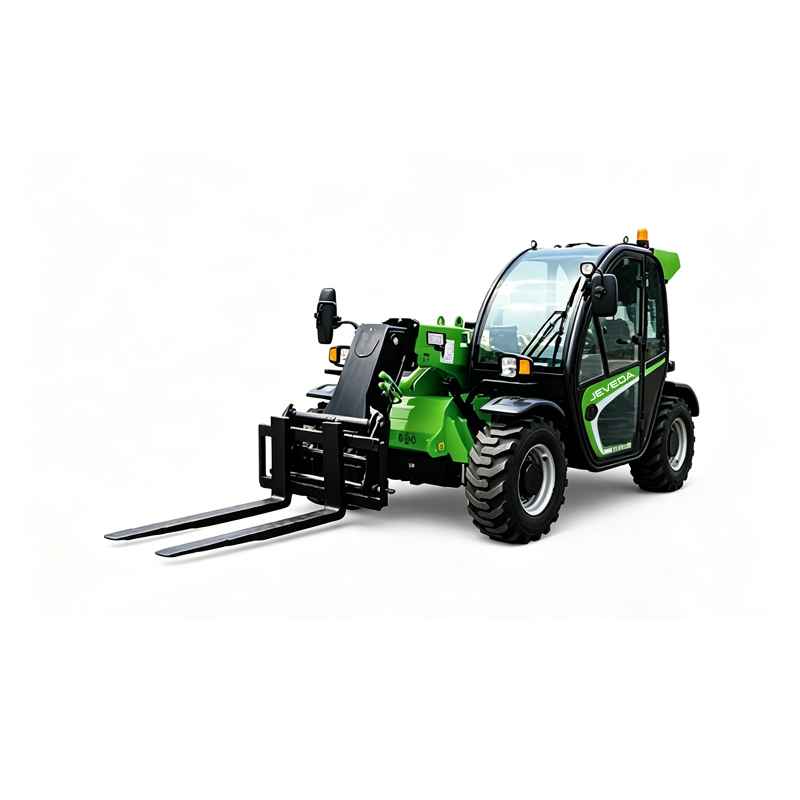 JT625-EV Electric Telehandler for Indoor and Yard WorkLithium-ion, zero-emission 2.5 t telehandler with 5.95 m lift, suited to livestock buildings, grain stores and yards where fumes and noise matter.View Product →
For genuinely mixed work — some field, some yard, some rough ground — the honest answer is usually a diesel all-rounder. The JT735 all-terrain telehandler is built for that spread: enough lift height for stacking, enough traction and ground clearance for a wet gateway in November.
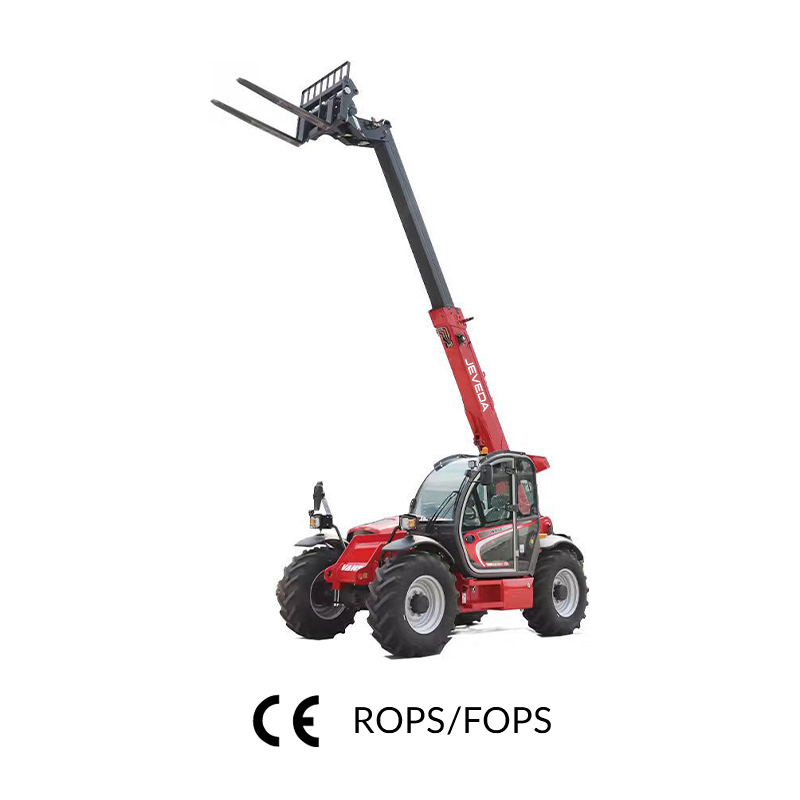 JT735 All-Terrain Telehandler for Mixed Field and Yard WorkA 3.5 t diesel telehandler with 7 m lift, 4WD, three steering modes and 430 mm clearance for field, yard and rough-ground duties.View Product →
It also helps to look at the machine as part of a fleet rather than in isolation. Our agriculture equipment solutions are organised around the whole season — feeding, bedding, mucking out, stacking and loading — and the telescopic handler range shows how the different sizes and powertrains sit alongside one another.
There is no universal answer, but a short sequence of questions usually settles it.
Used machines can represent excellent value, particularly late-life fleet units with tidy service records. Look closely at boom wear, hose condition, pin wear at the headstock and any sign of repair around the chassis. Electronics are harder to judge by eye, so a diagnostics check is money well spent.
An agricultural telehandler earns its place by being useful on a Tuesday afternoon in February, not by winning an argument about specification. Get the size right for your buildings and gateways, the height right for your stacks, and the attachments right for the work you do every week, and the machine will quietly become the one nobody wants to be without.
Everything else — the badge, the colour, the headline horsepower — tends to matter a great deal less by the second season.
Telehandler vs Lull: The Name on the Site, the Machine in the Yard On almost any construction site, someone will call a telescopic handler a Lull. The word tra...
READ MOREA telescopic handler, often called a telehandler, is one of the few machines that can lift, reach, place, load and carry on the same day without changing equip...
READ MOREMachine Guide · Electric Equipment Electric Telehandlers: The Quiet Power Behind Modern Job Sites Battery-powered lift machines have quietly moved from trade-s...
READ MORE
information
info@jevedamachinery.com
+86-571-86888355
No.1, Road One, Xindeng New District, Fuyang, Hangzhou, Zhejiang 311404, P.R.China
 China Compact Telescopic Forklift Manufacturers
 English
 русский
 Español
 Português
 Deutsch
 中文简体