en
Field notes · Telehandler selection
A telescoping boom raises the load. An articulated chassis helps the machine reach the work without asking the site to grow around it.
If you have spent time in a busy yard, an orchard, or a construction plot where every metre is already spoken for, you know the frustration: the lift itself is simple, but getting the machine into position is not. An articulated telehandler is built for that gap. It combines a telescopic boom with a chassis that pivots between the front and rear sections, so the machine can steer, turn, and place loads in spaces that would stop a rigid-frame machine.
This is not just a brochure feature. It changes how a day feels on site. Operators spend less time shuffling back and forth, less time asking people to move, and more time placing material where it is actually needed. The machine becomes a practical part of the workflow rather than a piece of equipment that has to be worked around.
A conventional telehandler usually relies on a rigid chassis with rear-axle or four-wheel steering. An articulated telehandler adds a pivot joint between the front and rear sections. The boom still extends and lifts, but the steering action comes from changing the angle between those two sections. In tight quarters, that layout can feel remarkably natural: the machine bends into the turn instead of swinging a wide arc around it.
The advantage is not only a smaller turning circle. It is the ability to approach a load from a slightly different angle, correct a placement without a long reverse manoeuvre, and keep the boom aligned with the work. On uneven ground, the articulated layout can also help the operator maintain control at low speed, provided the machine is rated for the surface and the load chart is respected.
A machine that can turn inside the gate is often worth more than a machine that can lift an extra tonne but cannot enter the yard.
Articulation tends to prove itself in places where the work is dense and the access is not generous. That may be a row of polytunnels, a farmyard with stacked pallets, an urban plot with hoarding and parked vehicles, or a rental yard where machines need to be moved frequently. We see the same pattern in construction site solutions: the telehandler is not chosen only by maximum lift height, but by how reliably it can deliver material to the right place without disrupting everything else.
It is also a good fit for rental fleets because a compact, manoeuvrable machine can serve many customers without demanding a large site. The trade-off is that articulation adds mechanical complexity, so maintenance attention matters more, not less.
| Aspect | Articulated telehandler | Rigid-frame telehandler |
|---|---|---|
| Steering layout | Frame pivots between front and rear sections | Rear-axle or four-wheel steering without a frame pivot |
| Manoeuvrability | Very tight turns and easy angular adjustment | Predictable travel, but a wider working arc in crowded space |
| Best fit | Confined yards, farms, urban plots, side-loading | Long reaches, high-capacity lifting, straightforward road travel |
| Watch point | Pivot joint, steering cylinders, and hose routing | Turning circle and rear swing in tight areas |
The boom is the platform; attachments decide how much of the machine’s potential you actually use. Pallet forks may be the default, but a telehandler can often be adapted to more than one job if the attachment is rated correctly and the load chart is adjusted for its weight and geometry.
Reach is measured along the boom, but usable reach shrinks as load increases. Always use the load chart for the attachment, boom angle, and machine configuration.
Not every site needs a full articulated chassis, but many need the same underlying qualities: compact dimensions, predictable placement, and a turning circle that respects the surroundings. For yards, farms, and urban work where noise and emissions matter, electric options are increasingly part of the conversation. They are not a universal answer, but they are a sensible one where charging access and duty cycle line up.
Our telescopic handler range includes compact and electric models that reflect this practical view of site fit. The JT625 is a compact telescopic handler for work where space is tight and straightforward placement matters. The JT625-EV brings an electric option into the same compact thinking, useful where low noise and zero tailpipe emissions support the working environment.
 JT625 Compact Telescopic Handler for Tight SitesA 1.8 m-wide compact telehandler with 2.5 t rated load and 5.95 m lift height, suited to tight access paths and confined sites.View Product →
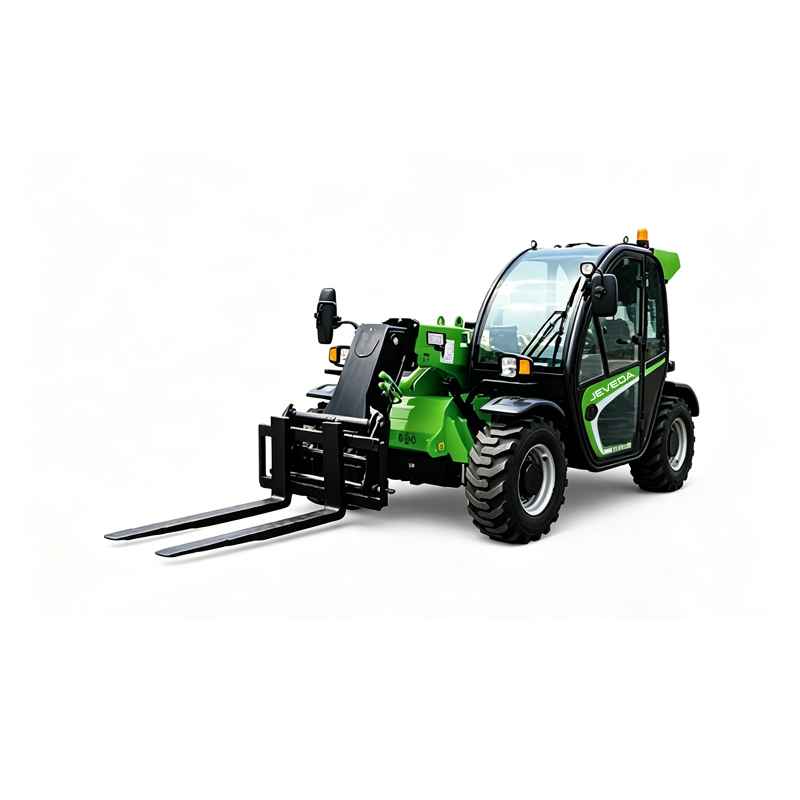 JT625-EV Electric Telescopic Handler for Indoor WorkLithium-ion, zero-emission telehandler with 2.5 t rated load and 5.95 m lift height; useful where low noise and indoor operation matter.View Product →
Start with the route the machine must take, not just the lift it must make. A compact telehandler that fits the access path is often more productive than a larger machine that needs the site cleared before every move.
When the load grows, the conversation changes. Stability, boom deflection, tyre choice, ground bearing, and travel speed all matter more. An articulated layout can still be valuable, but it must be judged against the load chart and the actual surface. High-lift work is not the place to improvise with an attachment or a travel position.
For heavier duties, the JT1840 heavy-duty high-lift telescopic handler represents the other end of the spectrum: a machine built around reach and lifting capability rather than pure compactness. The choice between compact and heavy-duty is a matter of honest site assessment, not a contest between models.
 JT1840 Heavy-Duty High-Lift Telescopic HandlerA 4,000 kg-capacity telehandler reaching 17.6 m high and 13.1 m outreach, built for heavier lifting and high-altitude work.View Product →
Never travel with the boom raised and the load extended beyond the manufacturer’s travel position. A telehandler can be stable on a load chart and still become unpredictable if it is moved outside the approved configuration.
Articulation changes steering geometry, but it does not replace the fundamentals. The operator still needs a clear exclusion zone, a level assessment, and a load chart that matches the attachment and the task. The rear swing of an articulated machine deserves particular attention; the rear section can move in a way that surprises people who are used to a rigid chassis.
Articulation does not replace a spotter or an exclusion zone. Keep people clear of the rear swing and boom path, especially in yards where pedestrians and vehicles share the same space.
An articulated telehandler rewards routine attention. The pivot joint, steering cylinders, hoses, pins, and tyre condition deserve regular inspection. Small leaks or worn bushings can turn into costly downtime if they are ignored, and the cost of a machine is never just the purchase price; it is also the parts, service, training, and time it consumes.
In our experience, the most useful buying conversation starts with routes, loads, ground conditions, and operators. That is less exciting than a headline lifting figure, but it is usually what keeps a telehandler productive after the first week.
An articulated telehandler makes sense when access is the real constraint. It offers tight turning, useful side-loading ability, and a more natural way to place loads in crowded spaces. It does not make every job easier, and it does not replace the need for a proper load chart, trained operators, and routine maintenance.
Choose the machine that fits the site you actually have: the gate, the yard, the surface, and the people who will work around it. A compact articulated or compact telehandler can be the difference between a machine that joins the workflow and one that forces the workflow to change around it.
The Agricultural Telehandler: One Machine, One Whole Season of Jobs A working guide to choosing, equipping and living with a telehandler on a real farm — writt...
READ MOREA telescopic handler, often called a telehandler, is one of the few machines that can lift, reach, place, load and carry on the same day without changing equip...
READ MOREMachine Guide · Electric Equipment Electric Telehandlers: The Quiet Power Behind Modern Job Sites Battery-powered lift machines have quietly moved from trade-s...
READ MORE
information
info@jevedamachinery.com
+86-571-86888355
No.1, Road One, Xindeng New District, Fuyang, Hangzhou, Zhejiang 311404, P.R.China
 China Compact Telescopic Forklift Manufacturers
 English
 русский
 Español
 Português
 Deutsch
 中文简体